
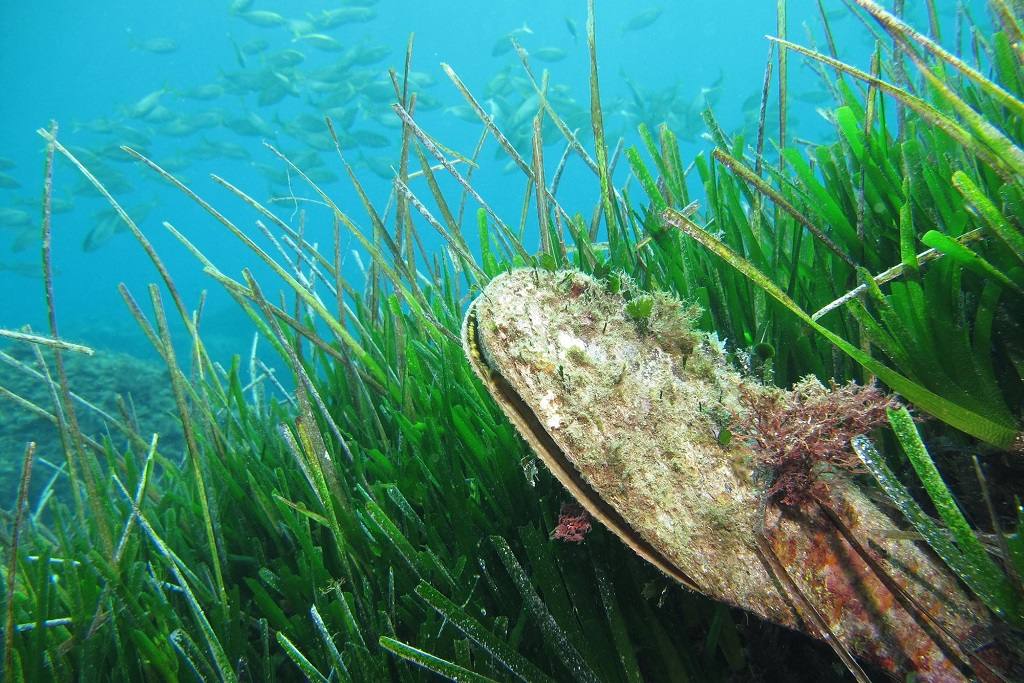
In recent years, the Mediterranean has witnessed a mass die-off of the Pinna nobilis - the large sea nacchera - one of the most impressive endemic bivalves in the basin. The event, which started in 2016 along the Spanish coast, has rapidly spread to the entire Mediterranean, causing the almost complete collapse of the natural populations. The main causes are attributable to a parasitic protozoan (Haplosporidium pinnae), often in synergy with opportunistic mycobacteria and unfavourable environmental conditions. In Sardinia, and particularly in the Gulf of Palmas and the Antioch lagoons, the situation reflects the Mediterranean crisis, but also offers insights into resilience and possibilities for environmental monitoring. The article reviews the scientific evidence, the current status of the populations and the conservation strategies underway.
Pinna nobilis L. (1758) is the largest Mediterranean bivalve, It can grow up to one metre in length. It lives embedded in the sediment by means of the byssus - a set of protein filaments - and prefers Posidonia oceanica meadows, a key environment for coastal biodiversity (Vázquez-Luis et al., 2017). In addition to its ecological value, Pinna nobilis possesses an important historical and cultural value: from its byssus was obtained the so-called “sea byssus”, a precious fibre used since antiquity and still today an integral part of the Sardinian textile tradition (Pes & Murroni, 1954).
The first documented episode of mortality was in the autumn of 2016, along the south-eastern coast of Spain (Darriba, 2017). Within a few months, populations were decimated, with mortalities up to 100%. The phenomenon quickly spread to France, Italy, Greece, Croatia and Turkey (Catanese et al., 2018). Microbiological investigations identified as the main culprit the protozoan Haplosporidium pinnae, new to science, associated with tissue necrosis and loss of filtering capacity. Subsequently, opportunistic mycobacteria (Mycobacterium spp.) were also isolated, which aggravate infections and further impair the immune capabilities of bivalves (Carella et al., 2019).
In Sardinia, the first reports of mortality occurred between 2018 and 2019 along the south-western coasts (ISPRA, 2020). In the waters of the Gulf of Palmas, between Sant'Antioco and Porto Botte, monitoring conducted by ARPAS and independent underwater biologists revealed a drastic decline in the density of Pinna nobilis, with dead individuals in situ and shells still embedded in the sandy seabed. In the Antioch lagoons and Santa Caterina Pond, where viable colonies were once present, extreme rarefaction is now observed. However, some local researchers have reported the presence of Pinna rudis - a related but more resistant species - and sporadic young specimens of Pinna nobilis in less brackish lagoon areas, potential ecological refuges where the pathogen could be less aggressive. According to ISPRA (2022 Report), “the Gulf of Palmas represents one of the sample areas for biological monitoring of the phenomenon in Sardinia”.
The parasite Haplosporidium pinnae attacks the animal's digestive system and glands, leading to progressive tissue necrosis. The spores spread through the water, rapidly colonising new hosts (Catanese et al., 2018). The process is aggravated by high temperatures, chronic environmental stress and alteration of Posidonia oceanica meadows, which deprives the species of its natural anchorage.
The disappearance of the Pinna nobilis has profound repercussions on coastal marine ecosystems, including the decrease in benthic biodiversity, the reduction in the filtering capacity of coastal waters and the alteration of Posidonia oceanica meadows. But the loss also affects the cultural memory of the Sardinian sea: the Pinna nobilis is an integral part of the traditions of Sant'Antioco, where sea-silk was for centuries a symbol of art and spirituality.
Conservation measures are focusing on several fronts: continuous coastal monitoring, genetic research on resistant specimens, protection of Posidonia meadows, and involvement of citizen science. In Sardinia, ex situ breeding experiments are underway at university marine centres, with the aim of preserving viable lines of the species while waiting for more favourable environmental conditions.
The death of Pinna nobilis represents one of the most serious biological crises in the recent history of the Mediterranean. Sardinia, with its central location and lagoon ecosystems, plays a strategic role in the conservation of the species. Sant'Antioco and the Gulf of Palmas can become laboratories of protection and rebirth, where science and culture come together to preserve what remains of a symbolic species of our sea.
Bibliographic references
Catanese, G., et al. (2018). Haplosporidium pinnae sp. nov., Journal of Invertebrate Pathology, 157, 9-24.
Carella, F., et al. (2019). Mycobacterial infection associated with mass mortality in wild Pinna nobilis. Scientific Reports, 9(1), 2725.
Darriba, S. (2017). First report of Haplosporidium sp. infecting Pinna nobilis in Spain. Aquaculture Reports, 7, 1-6.
Prado, P., et al. (2021). Habitat degradation and warming exacerbate the mortality of Pinna nobilis. Frontiers in Marine Science, 8, 666640.
(Roberto Lai - President A.N.C. Tutela Patrimonio Culturale)