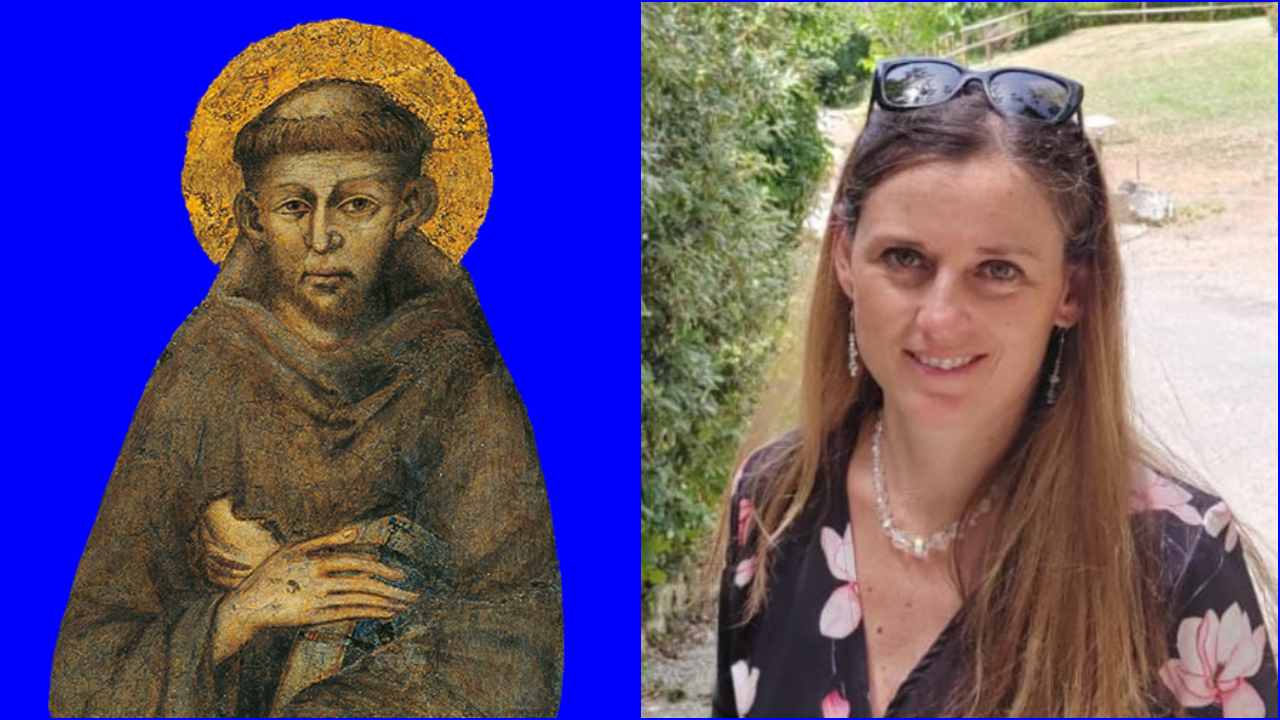
The eighth centenary of the death of Saint Francis of Assisi, which took place at the Porziuncola on 3 October 1226, provides a particularly significant opportunity to reflect once again on the relationship between humanity and the earth, between development and the stewardship of creation. This is not merely a matter of celebrating one of the loftiest figures in Christian spirituality and the Patron Saint of Italy, but of questioning the relevance of a vision that, eight centuries later, retains a surprising ability to speak to the anxieties of our time.
Often the Saint of Assisi has been presented in the media as a forerunner of modern environmentalism. In reality, his vision of nature stems from a profoundly theological perspective. The sun, water, fire and earth can be called «brother» and «sister» because they come from a single Creator. Brotherhood with creatures is therefore not the result of an indistinct assimilation of man into nature, but springs from the recognition of a common origin. Creation is a gift and, precisely as a gift, demands gratitude, respect and responsibility.
It is no coincidence that Pope Francis chose precisely the opening words of the Canticle of the Creatures, «Laudato si’», as the title of the Encyclical with which, in 2015, he offered the Church and the world a comprehensive reflection on the care of our common home. The 2026 anniversary also falls immediately after another significant Franciscan centenary: the eight hundredth anniversary of the Canticle, celebrated in 2025. Two anniversaries that almost seem to lead us back to the source of a Christian conception of the relationship with the earth and its resources.
An anthropological issue even before an environmental one
The ecological issue cannot be considered in isolation. Even before it concerns ecosystem conservation techniques, energy policies or ways of using resources, it raises a question about man: what place does the person occupy within creation? What responsibility falls to them? And what idea of development can be said to be compatible with human dignity and the safeguarding of the earth?
These are questions that have long run through the Social Doctrine of the Church. Sensitivity towards the environmental issue did not, in fact, originate with the Laudato si’. Already the Gaudium et spes he had highlighted man's responsibility towards created reality. St John Paul II, in the On Social Concern and in the Centesimus annus, would later develop the theme of ’human ecology«, while Benedict XVI, in the Charity in truth, she would have remembered that nature «precedes us and is given to us by God as a living environment».
It is a perspective in which man is not the absolute owner of the earth. Rather, he is its custodian and responsible steward. The biblical command to subdue the earth does not authorise arbitrary dominion, but entrusts the human being with a task that must be exercised with respect for the order of creation and the good of the entire human family.
With the Laudato si’ this tradition finds a new development in the concept of integral ecology. The environmental crisis is not an emergency that can be separated from other major social issues. The degradation of ecosystems, poverty, inequality, the exploitation of resources, the throwaway culture and the decline in the quality of relationships are all part of a single, complex crisis. «Everything is connected»: this recurring phrase in Pope Francis’s Encyclical encapsulates a concept that prevents us from artificially separating the protection of the environment from the protection of humanity.
Integral ecology cannot therefore be reduced to a series of virtuous individual behaviours, however necessary they may be. It implies a way of conceiving the economy, work, agriculture, production and consumption; it calls into question lifestyles, institutions, businesses and local communities. And above all it requires us to recognise that environmental degradation hits hardest those who have the least capacity to defend themselves: the poor, the most vulnerable rural populations, those who live in degraded areas, and the generations who will inherit the consequences of the choices made today.
La Magnificent humanityto care for the earth to care for the person
This setting finds an important continuation today in the Magnificent humanity of Leo XIV. Whilst addressing in a particular way the transformations brought about by artificial intelligence and the technocratic paradigm, the Encyclical places these issues within the broader horizon of the Social Doctrine of the Church and integral human development.
It is significant that Leo XIV expressly takes up the legacy of Laudato si’, recognising in the environmental crisis not a sectoral issue, but the ecological dimension of a more general socio-economic crisis. The «cry of the earth» and the «cry of the poor» cannot be separated. The universal destination of goods, intergenerational justice, the critique of the technocratic paradigm and the defence of human labour are thus brought back within the same horizon.
Particularly important is the statement according to which integral human development finds in integral ecology today a «decisive criterion of verification». It is not authentic development that which increases the wellbeing of some by deteriorating ecosystems, transferring costs onto the most vulnerable communities or compromising the living conditions of future generations.
This approach makes it possible to overcome a dichotomy that has often impoverished the environmental debate: on the one hand, an extreme anthropocentric conception, according to which nature is merely material at the disposal of human will; on the other, a conception that risks dissolving man's distinctiveness within the ecosystem.
The Christian tradition offers a different path. The peculiar dignity of the human person does not legitimise indiscriminate domination, but rather establishes a greater responsibility. Precisely because he is endowed with freedom, intelligence and moral conscience, man is called upon to answer for the consequences of his actions. His greatness is also measured by his ability to place limits on his own power.
This is where the stewardship of creation meets that «magnificent humanity» placed at the centre of Leo XIV's Encyclical. Caring for the earth means safeguarding the conditions in which human life can flourish; caring for humanity means recognising that its dignity cannot be separated from the relationships that bind it to others, to communities and to the environment in which it lives.
Earth as a received and shared good
From this perspective stems a consequence of particular importance for the agricultural and rural world. Land is not simply an economic asset. Certainly it produces income, food and labour, but its meaning cannot be reduced solely to its productive capacity. Soil is a limited, non-reproducible resource; it is the place where history, culture, social relations and forms of life are sedimented.
The universal destination of goods, a fundamental principle of the Social Doctrine of the Church, therefore acquires a precise environmental significance. The goods of the earth are meant for everyone. The right to property and economic initiative are legitimate, but they do not cancel out the social responsibility connected with their exercise. Using a piece of land, a water resource, a forest or any other natural good means assuming a responsibility not only towards the present, but also towards the future.
La Magnificent humanity it reiterates this link by recalling the responsibility towards the poor and towards future generations, and by demanding that the use of the goods of creation and the new possibilities offered by technology be regulated in such a way as to respect the environment, avoid waste and prevent new forms of plundering.
The issue assumes clear relevance in the agri-food sector. Agriculture today finds itself at the centre of complex tensions: it must guarantee sufficient and profitable production, respond to sustainability demands, preserve soil fertility and water resources, cope with the effects of climate change and, at the same time, ensure dignity and economic prospects for those who work the land.
A true integral ecology cannot demand environmental protection while ignoring the economic and social sustainability of rural communities. Conversely, however, no economic model can be considered sustainable if it progressively consumes the resources upon which it ultimately depends. The search for a balance between these requirements is not a compromise to the lowest common denominator: rather, it represents the concrete ground on which to measure the ability to translate the principle of integral human development into economic and political choices.
The value of the landscape
There is also an aspect of the environmental issue that assumes particular importance in Italy: the landscape. Our territory is the result of a centuries-old relationship between nature and human presence. Cultivated countryside, woods, terracing, vineyards, olive groves, paths, small villages, abbeys, sanctuaries and votive shrines form a heritage in which natural elements, productive activities, history and culture have mutually shaped one another.
Protecting the landscape therefore means protecting a memory. The degradation of a territory does not merely constitute an aesthetic or environmental loss, but can entail the weakening of the identity of the communities that inhabit it.
From this perspective, the theme of the «value-beauty» of creation becomes topical once again. Beauty does not represent an accessory element. It can become an educational principle. A well-tended landscape teaches that the territory is not an anonymous space to be consumed; it concretely shows the result of a balanced relationship between human activity and the environment.
Conversely, the abandonment of land, indiscriminate land take, illegal dumping, fires, water pollution, the loss of biodiversity and the gradual erasure of rural landscapes can breed a form of resignation. People become accustomed to degradation to the point of considering it inevitable.
It is precisely this resignation that must be combated. The environmental issue is in fact also a cultural and educational one. No legislation, however rigorous, can completely replace personal and collective responsibility. The protection of the land requires citizens capable of recognising the common good and of feeling co-responsible for its safeguarding.
From contemplation to responsibility
The lesson of Saint Francis takes on a surprising concreteness here. The Canticle of the Creatures It does not invite a disembodied contemplation of nature. Gratitude for what has been received necessarily implies responsibility towards the received gift.
The shift from contemplation to guardianship is perhaps one of the most important contributions that Franciscan spirituality can offer to the current debate on the environment. Even before rules and strategies, it is necessary to recover a gaze capable of recognising the value of things.
Hyper-technological and globalised societies tend instead to evaluate reality predominantly in terms of utility, efficiency and availability. This is the risk of the technocratic paradigm, which is so strongly emphasised by the Laudato si’ how much is it Magnificent humanitywhat can be technically done risks being considered, for that very reason, legitimate and desirable. But the ability to intervene in nature does not automatically coincide with the right to do so.
The development of technology increases human power and, precisely for this reason, makes responsibility even more necessary. The problem is not to oppose innovation, but to guide it. A technology is genuinely at the service of development when it improves the conditions of the person and of communities without producing new forms of exclusion and without transferring environmental and social costs elsewhere or into the future.
Leo XIV also significantly recalls the material impact of seemingly «immaterial» technologies: energy and water consumption, infrastructure, raw material extraction, and the human labour required to run digital systems. The artificial intelligence revolution, therefore, must also be brought back to the concreteness of the earth and its resources. There is no innovation that can be considered separate from the ecological question.
An alliance between agriculture, territory and community
In this context, the agricultural world can play a decisive role. The farmer is not only a producer of food goods: they are also, to the extent that they operate responsibly, a custodian of the soil, water, biodiversity and the landscape. The persistence of vital agricultural activities can combat the depopulation of inland areas, contribute to the prevention of hydrogeological instability and fires, preserve traditional knowledge and crops, and keep a social fabric alive.
Naturally, agriculture cannot be burdened with environmental responsibilities without acknowledging the costs. Land stewardship is a public good for the whole community and requires policies capable of supporting those who actually put it into practice. The ecological transition, to be fair, cannot be built against labour and local communities. It must be achieved with them.
This is where the principle of subsidiarity can offer a valuable criterion. Major environmental strategies require national and supranational policies, but their effectiveness also depends on the ability to value territories, associations, agricultural enterprises, intermediate bodies and local communities. The care of our common home requires co-responsibility.
For an organisation like Acli Terra, this horizon can translate into the promotion of an agriculture that combines environmental sustainability, the dignity of labour, food security, the protection of the land and the vitality of rural communities. These are dimensions that cannot be pursued separately without losing the authentic meaning of integral ecology.
Educating for stewardship
Ultimately, a decisive issue remains: education. Environmental transformations cannot be addressed exclusively through regulations, incentives or technological innovations. It is necessary to foster a conscience of responsibility.
Educating about stewardship means first and foremost educating about limits. Natural resources are not infinite and the fulfilment of every individual desire cannot constitute the ultimate criterion for development. Sobriety, from this perspective, does not coincide with sterile renunciation, but with the ability to distinguish what is necessary from what is superfluous and to recognise that one's choices have consequences for others.
It also means educating people on legality and the common good. Respecting the environment is not a private matter. Every behaviour that harms the land produces a collective cost. Likewise, every action of protection helps to preserve a heritage that belongs to the community.
Yet educating in guardianship means above all educating in relationship. This is perhaps the point where the lesson of St Francis, the Laudato si’ and the Magnificent humanity they converge more deeply. Individualism leads to the world being regarded as a sum of available goods; fraternity, on the other hand, teaches us to recognise bonds.
Eight hundred years after Francis
The eighth centenary of the death of Saint Francis should not, therefore, be reduced to a purely dutiful commemoration. It can become an opportunity to question the present and, above all, the future.
Eight hundred years after the passing of the Little Poor Man, the issue of safeguarding the earth has taken on dimensions that Francis could not have imagined. Yet his perspective retains a prophetic power precisely because it leads to the root of the problem: the way in which humanity perceives itself, others, and the world that surrounds it.
If the earth is merely a resource, the dominant criterion will inevitably be that of exploitation. If instead it is recognised as a gift, its use cannot be separated from responsibility. If the other is merely a competitor in access to goods, the logic of appropriation will prevail; if they are recognised as a brother or sister, the universal destination of goods will become a concrete demand for justice.
In this sense, integral ecology is much more than environmental policy. It is a vision of man and society. The Magnificent humanity It reiterates this by placing integral human development within the horizon of personal dignity, the common good, solidarity, social justice and responsibility towards future generations.
The agricultural and rural world represents one of the places where this vision can become a concrete experience. In cultivated land, in fact, nature and labor, technique and tradition, production and stewardship, personal initiative and collective responsibility meet. Precisely for this reason, agriculture can become a privileged laboratory for integral ecology.
«Sora nostra matre Terra», wrote Francis in Canticle, «which sustains and governs us». Eight centuries after his death, those words can be heard not only as one of the highest expressions of Italian religious poetry, but as a call to responsibility.
The earth sustains us, but in turn asks to be cared for. It has been entrusted to us by those who came before us and we must pass it on to those who will come after us. It is in this reciprocity between gift and responsibility that the memory of Francis meets the challenges of our time.
Safeguarding the earth therefore means safeguarding the person; defending human dignity means taking care of the environment in which their life can develop; promoting agriculture means recognising the value of the work of those who, by producing what is necessary to live, also contribute to the protection of the land.
Perhaps precisely here one of the most fruitful meanings of the Franciscan eighth centenary can be identified: rediscovering that contemplating, cultivating and caring are not separate actions, but dimensions of a single responsibility. A responsibility that concerns the earth, humankind and the future and which, from the perspective of integral ecology, can contribute to the construction of that «magnificent humanity» which remains entrusted, even today, to our choices.
Flavia Silli
University Lecturer in Philosophical Anthropology
Lateran University of Rome